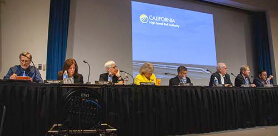
CEO報告

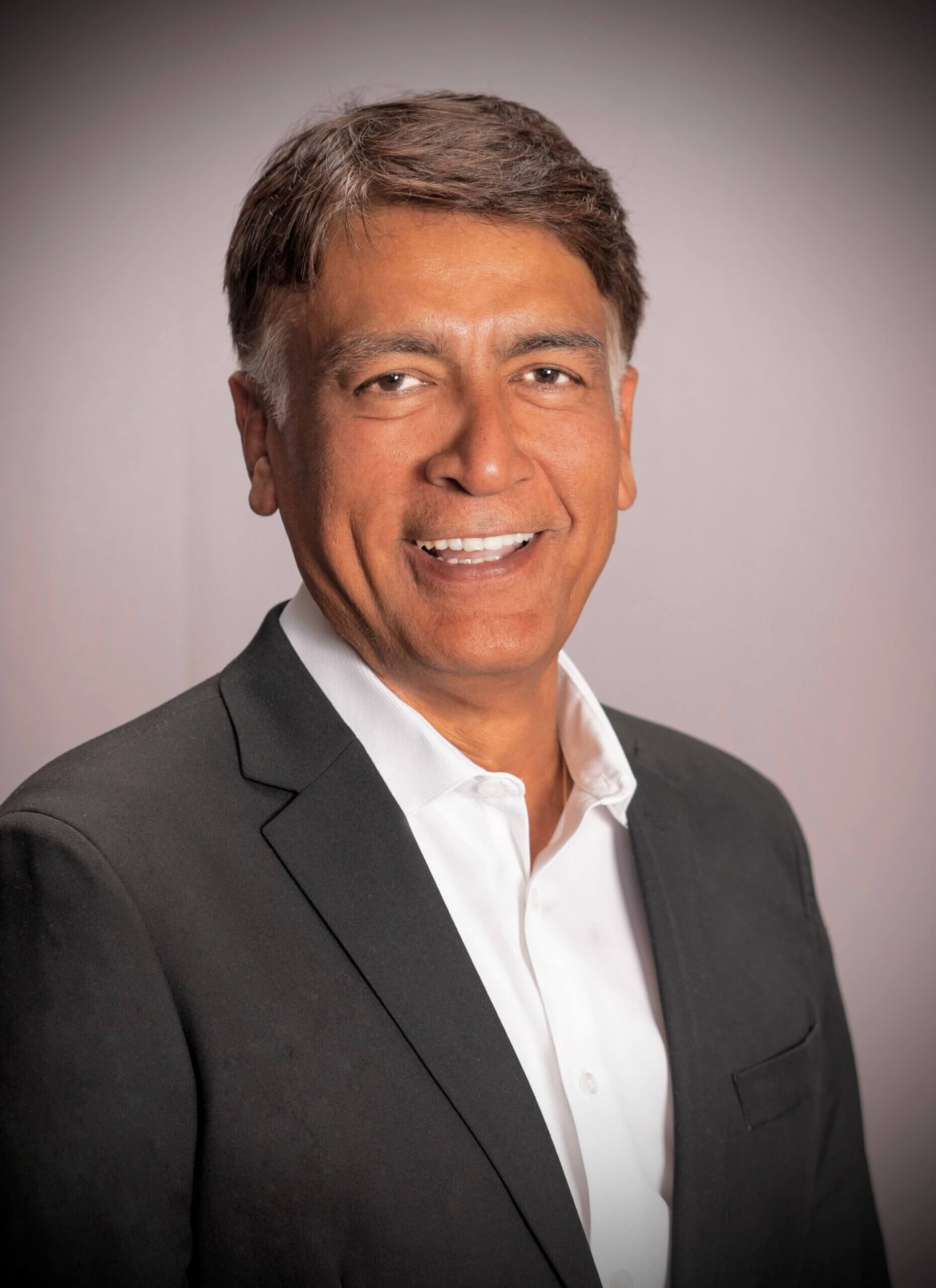
Ian Choudri, CEO2025年8月28日


2025年補充項目更新報告 | Implementing the New Vision Today | RFEI Responses | Legislative Support | 相關資料


2025 SUPPLEMENTAL PROJECT UPDATE REPORT

Buildout Scenario成本Funding Needed40-year Net Operating Profit / Loss
默塞德 – 貝克斯菲爾德36.758.59-3.8
San Francisco – Gilroy – Bakersfield 54.3826.2247.5
San Francisco – Gilroy – Bakersfield (including Merced)58.129.9445.9
San Francisco – Gilroy – Palmdale87.1258.9698.1
San Francisco – Gilroy – Palmdale (including Merced)90.8562.6996.8

IMPLEMENTING THE NEW VISION TODAY

  • MATOC (Multiple Award Task Order Contract)
    • Essential tool for large programs, streamlined approach for an agency to procure a wide range of construction with flexibility efficiency, & competition, ensuring that the agency gets the best value.
    • The MATOC will be utilized to execute a broad range of repair & minor construction projects on real property.
      • Flexibility & Efficiency
        • Saves time & cost for the Authority & industry
        • 靈活的合約可提供及時支持
        • Cost savings measure
        • 激勵績效
      • 增加機會
        • Allows access to an array of experts, innovation, & industry best practices
        • 能力建構
  • COMMODITIES PURCHASING
    • Staff analysis demonstrates purchasing long lead items will likely result in significant cost & schedule savings to the Authority.
    • This allows for fast, smarter, more economical track & systems installation.
      • Commodities Include
        • 混凝土連接件
        • 架空接觸網 (OCS) 桿
        • OCS組件
        • 光纖電纜
        • 壓載物
        • 紐森州長的預算提案包括對高速鐵路計畫的大力支持

RFEI RESPONSES

Major Key Themes among Developers & Investors

  • Long-Term Funding and Financing
    • Developers urge the establishment of stable, predictable Cap-and-Trade revenues, supported by statutory measures to improve credit quality and attract private investment for program financing
  • Collaboration and Early Contractor Involvement
    • Given the project’s complex integration needs, early private sector involvement and collaborative delivery models are broadly supported to optimize project scope and lifecycle costs
  • Public-Private Partnerships (P3s)
    • P3 models are recommended for large, complex projects like core rail infrastructure and extensions for bundled scopes in the $2-5 billion range and contract terms of 30-40 years, aligning funding and asset maintenance lifecycles
  • Availability Payment (AP) Model
    • APs are the most appropriate payment mechanisms for P3 delivery given current uncertainties in ridership and revenue projections
  • Advanced Purchasing
    • Advanced purchasing of long-lead time items can accelerate project schedules and secure competitive pricing upfront, but respondents emphasize the need to deploy such a strategy as part of a comprehensive procurement plan
  • Risk Allocation
    • Developers recommend clearly defining responsibilities and allocating risks to the parties best equipped to manage them, emphasizing the importance of integration and interface risks and mitigation tools

LEGISLATIVE SUPPORT

  • Stable & Secured Funding
    • The Authority remains committed to maximizing grant opportunities by actively pursuing federal, state, and local grants for infrastructure development, environmental sustainability, and transportation innovation.
    • There are considerable opportunities for the Authority and the State of California to engage with the private sector through a Public-Private-Partnerships (P3) delivery model. The level of state funding commitment will play a crucial role in attracting the private sector (P3) to participate and invest.
  • CEQA Exemptions For Renewable Power Generation Facilities
    • To help accelerate the project’s clean energy procurement and reduce delays associated with environmental review, the Legislature could enact legislation for a CEQA exemption for clean power interconnection, which could also encourage investments in sustainable infrastructure.
  • Streamlined Permitting
    • The Legislature could direct California regulatory agencies and the Authority to develop reasonable and prudent alternatives to current permit requirements that maintain the high-speed rail program’s core purpose while meeting environmental objectives.
  • Provision Of Dedicated Court Resources
    • The State could provide targeted judicial resources for program-related property acquisition cases, ensuring timely resolutions for the Authority, property owners, and local agencies coordinating parallel work.
  • Update Senate Bill 198
    • To provide flexibility for project sequencing and unlock private sector engagement, allowing the state and the Authority to invest these new funds back into the system to continue building, the Legislature could remove the limitations related to spending outside the Central Valley.
  • Third-Party Streamlining
    • What’s needed is a more structured and accountable framework that creates defined and binding timelines and ensures all parties operate under clear, enforceable expectations. These policy improvements would create the predictability and accountability necessary for successful delivery, protecting public investment and ensuring consistent progress across all segments of the program.
  • Encroachment Permitting
    • Authorize the Authority to issue encroachment permits to allow third-parties to access its right-of-way. This change would enable the Authority to partner with external entities looking to expand their growth area in a way that requires operating in or across the high-speed rail alignment.
  • Station Area Zoning and Tax Increment Value Capture
    • Empower the Authority with certain regulatory powers, including zoning and land use permitting controls, over land it owns and land within a one-half mile radius of high-speed rail stations, to facilitate the development of transit-oriented communities, and allow the Authority to capture sales and property tax increment resulting from such development to support station area infrastructure investments.
  • Sales Tax Exemption
    • Provide an exemption from sales tax for commoditized materials purchases for the construction of high-speed rail.

相關資料

Board of directors

董事會決議

查看董事會決議

接觸

董事會秘書
(916) 324-1541
boardmembers@hsr.ca.gov

加利福尼亞州高鐵管理局盡一切努力確保網站及其內容符合加利福尼亞州規定的Web內容可訪問性指南2.0級AA標準所規定的ADA規定。如果您要查找不在加利福尼亞高速鐵路管理局網站上的特定文件,則可以通過“公共記錄法”頁面根據“公共記錄法”來請求該文件。如果您對網站或其內容有任何疑問,請通過以下方式與管理局聯繫: info@hsr.ca.gov.