

About California High-Speed Rail
The California High-Speed Rail Authority (Authority) is responsible for planning, designing, building, and operating a high-speed rail system that will fundamentally transform how people move around California. The project will connect the state’s mega-regions, contribute to economic development and a cleaner environment, create jobs, and preserve agricultural and protected lands.
When completed, Phase 1 of the high-speed rail system will run from San Francisco to the Los Angeles basin in under three hours at speeds up to 200 miles per hour. The system will eventually extend to Sacramento and San Diego, totaling 800 miles with up to 24 stations. In addition, the Authority is working with regional partners to implement a statewide rail modernization plan to meet the state’s 21st century transportation needs.
Jump To
Goals | Progress | Milestones
Our Goals
Since joining the Authority in the fall of 2024, CEO Ian Choudri has set clear and urgent goals for the program:
- Right-size the project and build in the correct sequence – finding cost savings in a measured, responsible manner while staying laser-focused on starting track installation, testing, and operations within the initial 119 miles, and expanding service from there.
- Build faster, smarter, and more economically – rethinking how we plan and execute construction.
- Cut red tape and streamline operations – removing unnecessary processes and organizational redundancies that slow progress.
- Implement a new vision focused on connecting major population centers sooner – creating the conditions necessary to attract private investment into the program.
- Stabilize state funding and financing mechanisms – working closely with the Legislature to enact the state’s funding commitment.
Our Progress
- Construction is active across 119 miles in the Central Valley, with 86 out of 92 structures underway or completed, 70 miles of guideway completed, and 99 percent of properties needed in hand.
- 463 miles of the 494-mile Phase 1 system between San Francisco and Anaheim are environmentally cleared and construction ready.
- Design and pre-construction activities are underway to extend the 119-mile Central Valley segment to 171 miles from Merced to Bakersfield.
- Construction on bookend projects in Northern and Southern California is being advanced, with Caltrain electrification in the Bay Area completed.
Learn more about our construction progress: https://buildhsr.com/External Link
Learn more about project benefits: https://hsr.ca.gov/high-speed-rail-in-california/overview/
Project Milestones
- 2025 – Governor Gavin Newsom and the California Legislature approved reauthorization of California’s Cap-and-invest Program, securing a historic commitment of $1 billion for the program annually through 2045.
- 2025 – The Authority Board of Directors approved proceeding with procurements to purchase high-speed rail materials, a major milestone to accelerate track and systems construction, slated to begin in 2026.
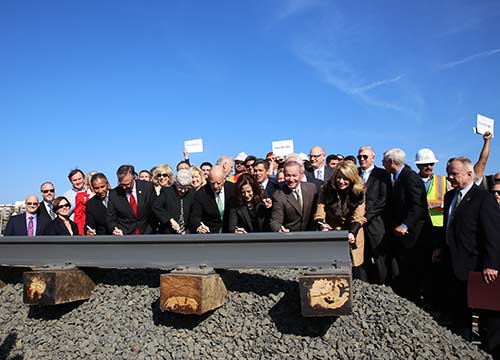
- 2025 – Governor Gavin Newsom joined leaders to officially kick off the Authority’s Railhead Project in Kern County, the first step in preparing for track and systems construction.
- 2024 – The Authority, the High Desert Corridor Joint Powers Authority, and Brightline West entered a Memorandum of Understanding with the goal of creating an integrated Southwest High-Speed Rail Network.
- 2024 – The 38-mile segment from Palmdale to Burbank was environmentally cleared, marking environmental clearance of 463 miles of the 494-mile Phase 1 system.
- 2024 – The California State Transportation Agency and the Authority renewed an agreement with the FRA to continue assuming the FRA’s federal environmental review responsibilities under the National Environmental Policy Act (NEPA).
- 2024 – The Authority’s Board of Directors approved SYSTRA | TYPSA to design track and overhead electrical systems for the initial 171-mile passenger service in the Central Valley.
- 2024 – Caltrain launched its 51-mile fully electrified rail service. The Authority contributed $714 million — about 40 percent of the total cost — to the project.
- 2024 – Construction Package 4, covering 22.5 miles in the Central Valley, reached substantial completion.
- 2023 – The Authority was recognized with the Excellence Award for Advancing Diversity and Social Change from the American Planning Association California – Northern Section, the Employer of the Year Award from the Women’s Transportation Seminar (WTS) San Francisco Bay Area and International Chapters, and the Rosa Parks Diversity Leadership Award from the WTS Sacramento Chapter.
- 2023 – The U.S. Department of Transportation awarded the Authority nearly $3.1 billion in grant funding for continued progress on the high-speed rail system in the single strongest show of federal support to date.
- 2023 – The Authority and 13 rail labor unions entered an agreement that ensures the hard-earned gains in federal labor laws will be applicable to the operations and maintenance workers on the high-speed rail system.
- 2022 – The $4.2 billion Proposition 1A (Prop 1A) funds that were requested by the Authority in 2021 were appropriated by the Legislature through Assembly Bill 180. This appropriation helps fund construction work in the Central Valley and allows the Authority to use Cap-and-Trade funds for other program priorities over time.
- 2020 – The Authority opened the Central Valley Training Center in Selma to train and certify journey-level professionals on various construction trades.
- 2020 – Despite the COVID-19 pandemic, the Authority significantly increased the number of workers dispatched, jobs created, small businesses involved, and structures completed, advanced bookend projects, and environmentally cleared the 171-mile Central Valley segment from Merced to Bakersfield.
- 2017 – The Authority received approximately $600,000 in brownfields grant funds through the U.S. Environmental Protection Agency (EPA) for project development work in the Los Angeles-Anaheim region.
- 2017 – Governor Jerry Brown and the Legislature approved AB 398, extending the Cap-and-Trade Program through 2030.
- 2016 – The Authority issued its first Sustainability Report outlining the sustainable approach to designing and building the high-speed rail system.
- 2015 – An official groundbreaking ceremony was held in Fresno to signify the beginning of construction. The first vertical structure started to take shape at the Fresno River Viaduct in Madera.
- 2014 – Work started on the first section of the Initial Operating Section (IOS) in the Central Valley, as well as on the electrification of the Caltrain corridor and early work in Southern California.
- 2014 – Governor Jerry Brown submitted his 2014-15 Proposed Budget to the Legislature, proposing to invest Cap-and-Trade proceeds to help fund the program.
- 2012 – The Authority published the 2012 Revised Business Plan with an implementation strategy that included building an IOS of high-speed rail and integrating high-speed rail improvements with existing rail systems.
- 2008 – Proposition 1A was approved by California voters, making it the nation’s first ever voter-approved financing mechanism for high-speed rail. After more than a decade of research, planning, engineering, environmental and economic review, and public and legislative debate, the California high-speed rail system was poised to move toward construction.
- 1996 – The Intercity High-Speed Rail Commission determined high-speed rail in California was feasible. The Legislature created the Authority to oversee implementation.
- 1994 – As part of the High-Speed Rail Development Act of 1994, California was identified as one of the five corridors nationally for high-speed rail planning. The California Legislature created the Intercity High-Speed Rail Commission and tasked it with determining the feasibility of a system in California.
- 1981 – California pursued the idea of a Southern California high-speed rail corridor working with Japanese partners.
 English
  Español de México
  العربية
  Հայերեն
  Hmong
Hmong  繁體中文
繁體中文  香港中文
香港中文  简体中文
简体中文  한국어
한국어  日本語
日本語  ਪੰਜਾਬੀ
  Tagalog
  Tiếng Việt